egyptiansecrets

Alternative Egyptology as a pathway of spiritual growth.

Friday, March 31, 2006

Atlantis, Plato, and Cycles of Time

Written history gives us a record, more or less, of the last 6000 years of human thought. We can see into the mind of an ancient resident of Egypt, Babylon or India from the writings he has left us. Beyond that 6000 year barrier, there are no written texts, no inscribed stones. We have mute tools and artworks and we have legends.

In the regions near the Atlantic Ocean the legend of a great flood is so common that a historical basis is very likely. And the civilization that was destroyed by that flood had a name that even today has great power: Atlantis.
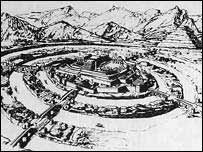
The capital of Atlantis was surrounded by concentric rings of water and land

Our knowledge of Atlantis is based on many minor bits of evidence - and one document that may rise to the level of history. That is a short section in a work by Plato called Critias. An ancestor of Plato named Solon traveled to Egypt about 600 BC and lived for a time in Sais (Zau), then the capital of Egypt and an ancient center of learning on the Nile Delta. Here he befriended the local priests and discussed many things with them.

The history held by that Egyptian temple reached much farther back in time than that known to the Greeks. "There have been, and there will be again, many destructions of mankind arising out of many causes." an aged priest told Solon.

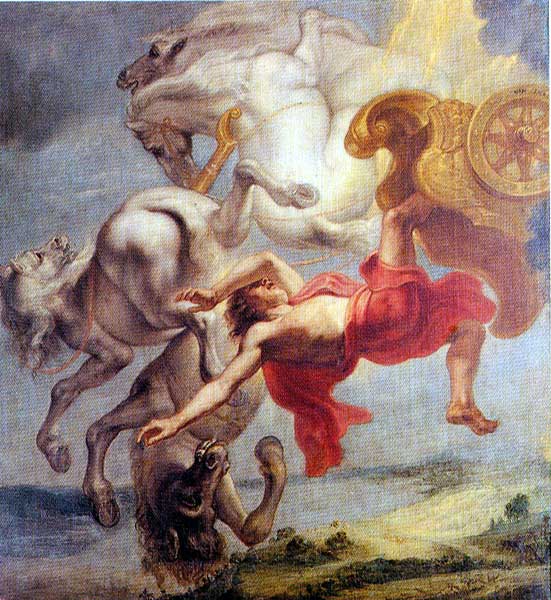
"There is a story which even you (Greeks) have preserved, that once upon a time Phaethon, the son of Helios, having yoked the steeds in his father's chariot, because he was not able to drive them in the path of his father, burnt up all that was upon the earth, and was himself destroyed by a thunderbolt.
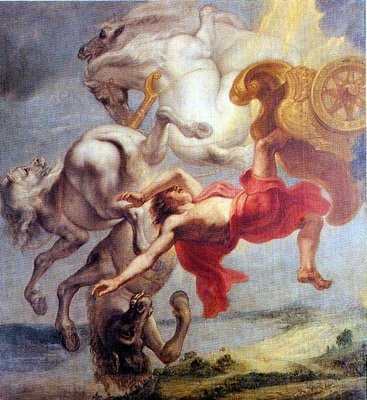
Lightning strikes the chariot, the horses and Phaeton tumble from the sky.
Phaeton, by Jan van Eyck c.1390 - 1441

"Now, this has the form of a myth, but really signifies a declination of the bodies moving around the earth and in the heavens, and a great conflagration of things upon the earth recurring at long intervals of time. When this happens, those who live upon the mountains and in dry and lofty places are more liable to destruction than those who dwell by rivers or on the sea-shore; and from this calamity the Nile, who is our never-failing savior, saves and delivers us.

"When, on the other hand, the gods purge the earth with a deluge of water, among you herdsmen and shepherds on the mountains are the survivors, whereas those of you who live in cities are carried by the rivers into the sea; but in this country (Egypt) neither at that time nor at any other does the water come from above on the fields, rather having always a tendency to come up from below, for which reason the things preserved here are said to be the oldest."

These few words point directly at what so much else hints, that there have been cycles upon cycles of growth and decline, each cycle perhaps developing a different aspect of human consciousness, and each decaying and falling as the limits of human character are tested.

"The fact is," says the priest of Sais, " that wherever the extremity of winter frost or of summer sun does not prevent, the human race is always increasing at times, and at other times diminishing in numbers."


This pattern of expansion and decline is known to the Maya and the Vedas of India. It also can be seen in the cycles of the animal world. Growth is not a linear affair, after a time the rigidity of the past so constricts further expansion that in order to allow space for the new there must be an autumn and a winter.

Where our present-day civilization is in the cycle I leave to the imagination.


And what of Sais? Solon was told "all that has been written down of old ... is preserved in our temples".

No longer, it seems. 2600 years have all-but removed the temples of Sais from the surface of the Earth. The Delta is not as kind to ancient buildings as is the desert of Egypt and there is almost nothing to be seen in Sais today.

Hope remains - little archeological digging has yet been done there and increasingly subtle techniques can discern much that would previously be missed.

Perhaps an ancient storeroom of records will someday be found at Sais. Perhaps this knowledge of our lost human past, kept secret by countless generations of initiates only to be lost, (we assume), at the beginnings of the Christian era will be found again.

Atlantis

For more on Atlantis see the Ascending Passage:
Atlantis Page


Ascending Passage is a website exploring Ancient Egypt with awe and wonder yet with respect for science. The proven historic facts of this ancient culture are amazing enough...
AscendingPassage.com


Hints of great civilizations in the forgotten past are by no means confined to Egypt. AncientMystery.info looks at unanswered archaeological questions from around the world:
AncientMystery.info


Labels: , ,

Friday, February 24, 2006

The Mysterious Osirion at Abydos

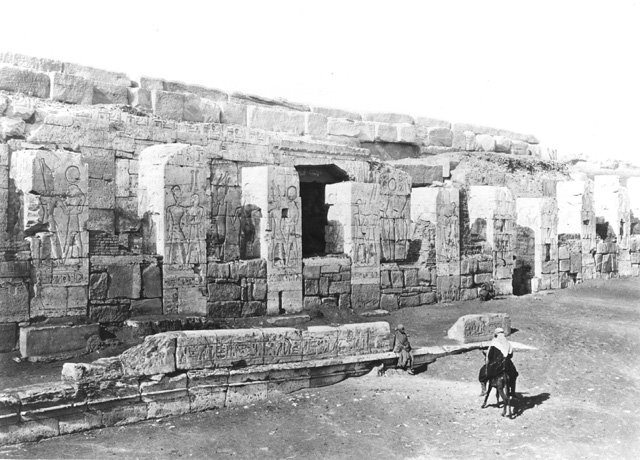
Abydos (the Egyptians call it Umm el-Qa'ab) was the capital of early Dynastic Egypt, before the center of government was moved north to Memphis. This remote site, seldom visited by tourists, is the location of perhaps the finest New Kingdom temple, built during the rule of Seti I (Sety I), the first important pharaoh of the Nineteenth Dynasty. In 1902, behind that temple, William Flinders Petrie and Margaret Alice Murray discovered the Osirion (Osiron or Osireion).

Entrance to the temple of Seti I at Abydos
The Entrance to the Temple of Seti I, from the outer courtyard.


While every New Kingdom temple in Egypt is different, adapted to the attributes of the god (neter) that it serves, they also have many characteristics in common. For example, all are built at ground level from stones of one or two tons weight and all have nearly every available space carved and painted. The Osirion breaks those rules. The floor is located 40 feet below the present ground level, the stones used in its construction often weigh 60 tons, and most of the walls are not decorated.


Abydos is the cult center of Osiris, the god of death and rebirth and there is little doubt that this strange structure is dedicated to him. But when was it built? The conventional explanation is that it was Seti I or his grandson Merenptah who caused it's construction, but advocates of an earlier, lost, pre-dynastic civilization in Egypt have noticed that the Osirion resembles only two known buildings - the two temples beside the Sphinx.

These two, called today the Sphinx temple and the Valley temple, are known to have been built from the stone removed from the base of the Sphinx during its' construction. This would place them, by conventional dating, in the Fourth Dynasty, about 4,500 years ago and over a thousand years before Seti.

Geologist Robert Schoch has examined the erosion of the Sphinx and the nearby temples and concluded that they were subject to heavy rain, a condition that ended in that region about 8000 years ago. His conclusion, to which other geologists concur, is a central piece of evidence in the argument for an earlier, so far undiscovered, civilization on the Nile.

So, how old is the Osirion? I recently examined the report of Mr. Petrie and Miss Murray who excavated the site in 1902-3.

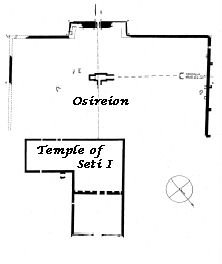
"The cartouche of Merenptah appeared in every place where it could be inserted" says Miss Murray. Egyptian Research Account: 1903 While this could mean merely that Merenptah repaired an existing building, it should not be dismissed lightly. The temple of Seti is "L" shaped, the Osirion located beyond the central chapels. Thus the support areas are located on the side, rather than behind the central chapel, as they are in other temples. This conveys the idea that either the Osirion was considered more important than the chapels (Egyptian temples are arranged in a progression from the common to the most holy), or that it was pre-existing and Seti built his temple carefully in line with it. Thus the Seti Temple and the Osirion form a architectural whole. But Merenptah began his rule 34 years after Seti I's death.

Map of the Osirion and the Temple of Seti I in Abydos
The floor plan of the Temple of Seti I
and the portion of the Osirion discovered in the 1903-4 excavation season.
The entire Osirion is nearly as wide as the main section of Seti's temple
and includes most of the area between the portion shown and the temple.
Map drawn by Margaret Alice Murray


The Osirion is the only temple known from Ancient Egypt to be built below ground level. This has been presented as evidence that it is much more ancient than the adjacent Temple of Seti I, the slow deposition of silt raising the ground level over time. On this point Miss Murray will disagree:

"The nature of the desert is that after removing from two to four feet of loose wind blown sand, the hard marl, called gebel by the workmen, comes into view. This is so firmly compacted together that it can be cut like rock. The ancient builders took advantage of this fact, and excavated passages and halls with steeply sloping, almost perpendicular, sides. These were lined and roofed with great blocks of stone, and the hollow at the top filled up with sand; the building was then completely hidden from the outside. In our clearance it was only necessary to descend a few feet till the rock-like gebel was exposed, and then to follow down the excavation; and the trial pits that we sunk within the temenos invariably showed that the gebel had been cut perpendicularly to admit of building below." ibid

To recount Miss Murray: The desert in the area consists of loose sand to a depth of a few feet. Below that is gebel, basically rock. This rock was cut out to allow the building of the Osirion. Deposits of sand that contained Roman rubbish were not at all solidified.

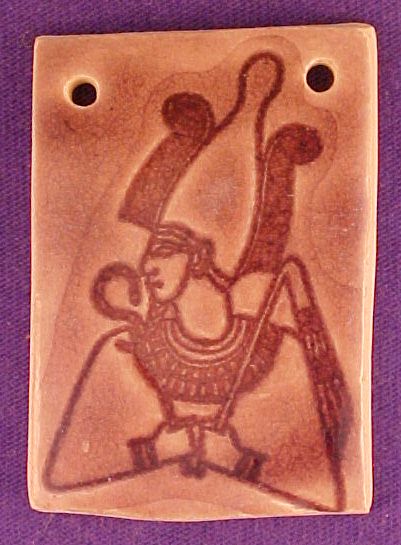
OsirisWhat secret ceremonies took place in these strange underground chambers? Osiris was the god of rebirth - perhaps the fertility ceremony each spring was centered here. Like a Native American Kiva, a dark underground space can make spirit more powerful.

Could it have been an ancient, lost, civilization that cut away the rock and built the Osirion? Yes, it could have been, but there is nothing here to make that point, beyond the uniqueness of the design and the size of the stones. And it should be remembered that Sir Petrie, unlike modern archaeologists, was quite willing to accept the existence of an earlier, yet undiscovered civilization in Egypt.

Osiris was believed to have been a king in pre-historic, legendary times. Egyptian tombs were built underground - could this be his? Or is the nature of this site so removed from our way of thinking that we cannot comprehend its' purpose?


The report of Mr. Petrie and Miss Murray can be seen at:
AscendingPassage.com/Osirion-at-Abydos.htm

An overview of alternative theories of Ancient Egypt is :
AscendingPassage.com

There are many mysteries and secrets that hint of earlier, lost, civilizations:
AncientMystery.info

Great jewelry of Tibet and Nepal:
Tibetan-Jewelry.net


Labels: , , ,

Friday, October 21, 2005

BaalBek - Ancient Temple of Mystery

In the remote Bekaa Valley of Lebanon stand the ruins of what was once the most important temple in the Roman Empire. Here stood the Temple of Jupiter, and the great oracle upon whose words decisions of the Empire were made.

The ruins of Baalbek in dawn light
Baalbek, a painting by David Roberts, 1839.


Baalbek lies at the ancient crossroads of Palestine in the south, Damascus in the east, the sea in the west and Hamath in Upper Syria to the north-east. There is the possibility that it is the Biblical city of Dan, center of worship of the Northern tribes of Israel and a thriving center 800 years before Christ.

To the Romans it was Heliopolis, sharing the name with the important center of Sun worship in Egypt. The known, existing ruins - the massive Temple of Jupiter, the Temple of Bacchus, and the small Temple of Venus, are believed to be from Roman times by historians and, although the site is known to have been occupied as long ago as 2900 BC, the story ends there in the conventional mind.

A number of factors argue for an earlier date. There are no substantial records of the construction of Baalbek, a surprising omission for the Roman bureaucracy. The Giant Stones of the Jupiter Temple do not look like Roman stonework and are much larger than those used elsewhere. Baal is not a Roman god - it is the golden calf of the Bible - the Apis cult that should have died out at the end of the age of Taurus, somewhere around 2200 BC.

Then there is the famous oracle, as valued to the Romans as that at Delphi. Oracles are not created by Emperors. One must go to the place chosen by the gods.

And why would the Romans build a temple of Jupiter - god of thunder - in a place called Heliopolis? The Roman Emperor Aelius Antoninus Pius (138-161 AD) did extensive renovation at the site. A footnote to Immanuel Velikovsky's article on Baalbek may point to the answer: "... 65. Robinson suggested that Antonine rebuilt the great temple of the Sun and erected the lesser temple to Jupiter Baal (Biblical Researches, III, p. 520, n.6)."

Is the greatest temple of Baalbek still to be discovered?


Giant stones in the wall of BaalbekThis old photograph shows a portion of the back wall of the Temple of Jupiter at Baalbek. There is a prominent indentation on the lower of the two rows of large stones. A man is standing by the left most stone of this row to show the scale of the picture. The lower of the two large rows is composed of stones 14 X 10 X 33 feet weighing about 300 tons (130,000 kg). This row or course circles the temple area and forms a solid platform with the floor. The course above it - the large stone shown, and two others, one of which is shown partly, form the Trilithon - the largest building stones ever used in construction anywhere in the world. Each stone is 14 X 12 X 64 feet and weighs an estimated 800 tons (700,000 kg). It is these stones that so encourage those who believe that there were earlier high civilizations in the Mediterranean that are now lost to history.

For a more in depth discussion of the stones of Baalbek see the AncientMystery.info
BaalBek Page


Hints and glimpses of an ancient mystery - the lost history of the Human Race, before the meager 6,000 years from which we have written texts:
AncientMystery.info


For a look at Egypt from a different perspective than that promoted by mainstream archeology:
AscendingPassage.com


Labels: , ,

Friday, October 14, 2005

Edgar Cayce, Egypt, and Atlantis

Perhaps the grandest mystery of archeology is the origin of Egyptian civilization. We have only simple pottery and stone tools from the time period a few hundred years before the building of the pyramids - the largest and most accurate stone structures on the Earth. When pressed the archeologists will admit that there probably was a previous civilization, but it is a subject they prefer to avoid. Discussing pre-historic era Egyptian civilizations quickly gets too close to the forbidden "A" word:

Atlantis


Edgar Cayce was an American psychic who lived from 1877 to 1945. His belief was that our current problems and challenges are often continuations of issues from previous lives. Since, in his view, the current time is a reflection of portions of the Atlantian experience, many of his readings involved Atlantis.

According to Cayce, Atlantis was a highly developed civilization with technology comparable to ours, but based on different energies. This civilization first rose over 50,000 years ago but destroyed itself through misuse of an energy it obtained by feeding Solar energy through crystals into the Earth. Atlantian technology rose again only to be destroyed by internal warfare. It rose yet a third time, this time to be destroyed by flood, memories of which are in the Bible and are known to many other cultures.

Refugees from this third catastrophe emigrated to several places, including Egypt. There, on the Nile Delta they established a colony, eventually creating a high culture. It is the records of this culture that were studied by the builders of the Pyramids, and that formed the basis of Egyptian Art, Spirituality, and written Language.


This chronology from Edgar Cayce fits fairly well with the Ancient Egyptian's own tradition of the times of the Gods (Atlantis) and Companions of Horus (undiscovered pre-historic civilization on the Delta). The time given for Atlantis also coincides with the time of Cro-Magnon Man - early Homo Sapiens with refined features and a larger brain than we have today.

Cayce places the building of the Pyramid and Sphinx in the first (now lost) Egyptian civilization, about 12,000 years ago. If we accept Geologist Robert Schoch's analysis of the weathering of the Sphinx and the Sphinx Temple nearby, then this date is credible. The Pyramid referred to, perhaps, may be seen in the large stones at the base of Chephren's Pyramid (the second largest, which stands behind the Sphinx), allowing the currently standing pyramids to be the work (mostly) of historical Egypt, as the archeologists insist.

Edgar Cayce mentions that a great Hall of Records was carefully placed near the Sphinx and awaits discovery. A reading given by Cayce in 1933 says this Hall contains:
"A record of Atlantis from the beginning of those periods when the spirit took form, or began the encasements in that land; and the developments of the peoples throughout their sojourn; together with the record of the first destruction, and the changes that took place in the land .....(documents) that are as copies from the sunken Atlantis.

...The Sphinx ... was set later as the sentinel or guard and which may not be entered from the connecting chambers from the Sphinx's right paw until the time has been fulfilled ... Then it lies between the Sphinx and the river." (378-16; Oct. 29, 1933)
(Quote from "Edgar Cayce on Atlantis" by Edgar Evans Cayce, page 148.)

There have been a number of attempts to find this Hall of Records, ground penetrating radar has found chambers or caves below the Sphinx and a drill core from nearby contained granite from Aswan, hundreds of miles upriver, but the Egyptian Department of Antiquities has so far refused to allow further exploration.


Portions of this entry and more information on Edgar Cayce and Atlantis can be found in the Atlantis section of the AscendingPassage website:
Click here to go to the Atlantis Section


For a look at Egypt from a alternative perspective than that promoted by mainstream archeology:
Click here to go to AscendingPassage.com


The pyramids have their own website, the many mysteries of these giant precisely built structures are still well beyond modern technology:
Click here to go to the Pyramids


There are anomalous artifacts and meaningful mythology in many places throughout the world. AncientMystery.info explores the faint traces of a great and different ancient knowledge.
Click here to go to http://ancientmystery.info/


Labels: , , ,

Monday, October 10, 2005

John Anthony West - a different view of Ancient Egypt

There are a few books that really affect me, books that start me looking at things in a different manner. "The Serpent in the Sky" by John Anthony West is not easy to read, but it will reward those who give it their time with a deeper understanding of the astounding culture whose relics still stand along the Nile.

Ancient Egypt presents a quandary for scholars. The architectural marvels created by this civilization defy explanation. The sheer beauty of their art is beyond comparison. And yet most Egyptologists hold tightly to the superiority of modern knowledge and abilities, speculating on vast armies of workers building the Pyramids and dismissing the contents of medical texts as superstition.

John Anthony West calls this academic bias the "Church of Progress" and attempts to defend and explain the world view of the Egyptians, drawing heavily on the work of Rene Schwaller de Lubicz, a French Alchemist who spent twenty years unraveling the symbolic roots of Ancient Egypt.

To de Lubicz the placement and subjects of art in Egyptian temples, the dimensions of their walls, and the geographical location of those temples all have specific meaning, and all are related to the overall scheme of man's place in the universe. The ancient saying attributed to Hermes: "As above, so below" is marked out in every stone of every temple.

According to John Anthony West: "Schwaller de Lubitz claimed that Egyptian civilization was based on profound and precise knowledge of the mysteries of Creation. The Symbolist interpretation supports this claim with two kinds of evidence; the first linguistic, the second mathematical." The Serpent in the Sky, page 34.

Thus "the sign (for 'bird') refers not only to the physical bird, but also to all the functions and properties that are contained within the 'idea' of bird: the ability to fly, to escape from the Earth, and hence the principle of volatility which ultimately implies 'spirit'." ibid page 41.

And: "What is today called Pythagorean number mysticism is Egyptian in origin (if not older still) and corresponds to the underlying philosophy behind all the arts and sciences of Egypt." ibid page 44.

To the Egyptian priesthood the ultimate secret was the original division of the Unformed Chaos into two parts - the moment of the creation of the Universe. This break was in the ratio of the Golden Section, about 1 to 1.6, an uneven geometry that has defined growth and harmony in the world we know.

The golden section was rarely used in Egyptian art and architecture, more often it was hinted at or suggested. But harmonics abound and give much power to the things we see today.

The symbolist view of Ancient Egypt and the mysteries and secrets of the Nile culture are explored in my website AscendingPassage.com. More information on West and De Lubicz is included, along with commentary and links to a number of websites that attempt to touch the deep spiritual truths so evident in this ancient land.

Click here to go to AscendingPassage.com


The giant columns of an ancient temple are set against the mountains beyond.
Part of the grand Egyptian Temple of Karnac, near ancient Thebes.
Etching by the Scotsman David Roberts, 1838.


Some other websites that may be of interest:

All over the world there is evidence of astounding knowledge in Ancient times, knowledge of a different kind than that of today. We have only a few hints of what has happened on this Earth in ages past. AncientMystery.info reveals a few of the secrets that most historians neglect.
Click here to go to AncientMystery.info.


Tibet is a most dramatic place to travel. A thoughtful tale of my own journey there is TravelinTibet.

Click here to go to TravelinTibet.com


Beautiful handcrafted jewelry of Nepal and Tibet is available for sale:

Click here to go to AccentNepal.com
- which is an Ebay hosted store, and also:

Click here to go to JewelryTibet.com

- an independent wholesale jewelry store open to the public.


Tibetanjewelry.net is a brief look at some of the more common Tibetan Spiritual symbols, with pictures and descriptions.
Click here to go to TibetanJewelry.net


XSVS is about scientists who break out of the confines of accepted thought. Button sorters will be disturbed. Science and Spirit are in the end the same quest. We need not discard our intellect in our search for spiritual truth.
Click here for where Spirit meets Science


Many of these web sites are expanded directories, combining commentary with links to selected websites. The central directory is: WhyCat.com. The paranormal, mysterious, sacred, and unconventional are explored in Whycat. You can randomly browse these pages, there is no predicting what you will find.
Click here to go to WhyCat.com


The Earth's web of life is battered and torn these days - a clear reminder of how unconscious acts can cause lasting damage. Healweb.com looks at some possible answers.
Click here to go to HealWeb.com


Domain Names are a must for anyone building their own website. There are few good .com names remaining so many webmasters are turning to alternative extensions for Domains. TLDV.com is a guide to Domain Names and the large number of top level extensions that are available.
Click here to go to tldv.com


ShaktiNode is about energy: Prana - Chi - Orgone - the unseen (by most) life force that is the deeper basis of the Universe. Save this site for last!

Click here to go to ShaktiNode.com


Labels: , , ,